The UK CMA veterinary ruling: what every practice needs to know

March 31, 2026
|
5 min read
|

If you run a veterinary practice in the UK, you've probably been watching the Competition and Markets Authority (CMA) investigation for months. Today, the final report landed – and with it, a set of legally binding requirements that will change how every UK practice handles pricing, prescriptions, estimates, and complaints.

Here's what you need to know, what's changing, and how Provet is already helping practices stay ahead.

What the CMA found

The CMA's market investigation into veterinary services for household pets concluded that a lack of clear, accessible pricing information is producing weak competition and higher costs for pet owners across the UK. While the investigation focused heavily on the largest corporate groups, the new rules apply across the board – independent practices and multi-site operators alike.

The result: a set of legally binding remedies designed to give pet owners more transparency and more choice.

What's required – and by when

The CMA has six months (until 23 September 2026) to put its Orders in place. Once those Orders land, the clock starts for your practice. The full list of requirements is on GOV.UK. Here's a breakdown of the key ones.
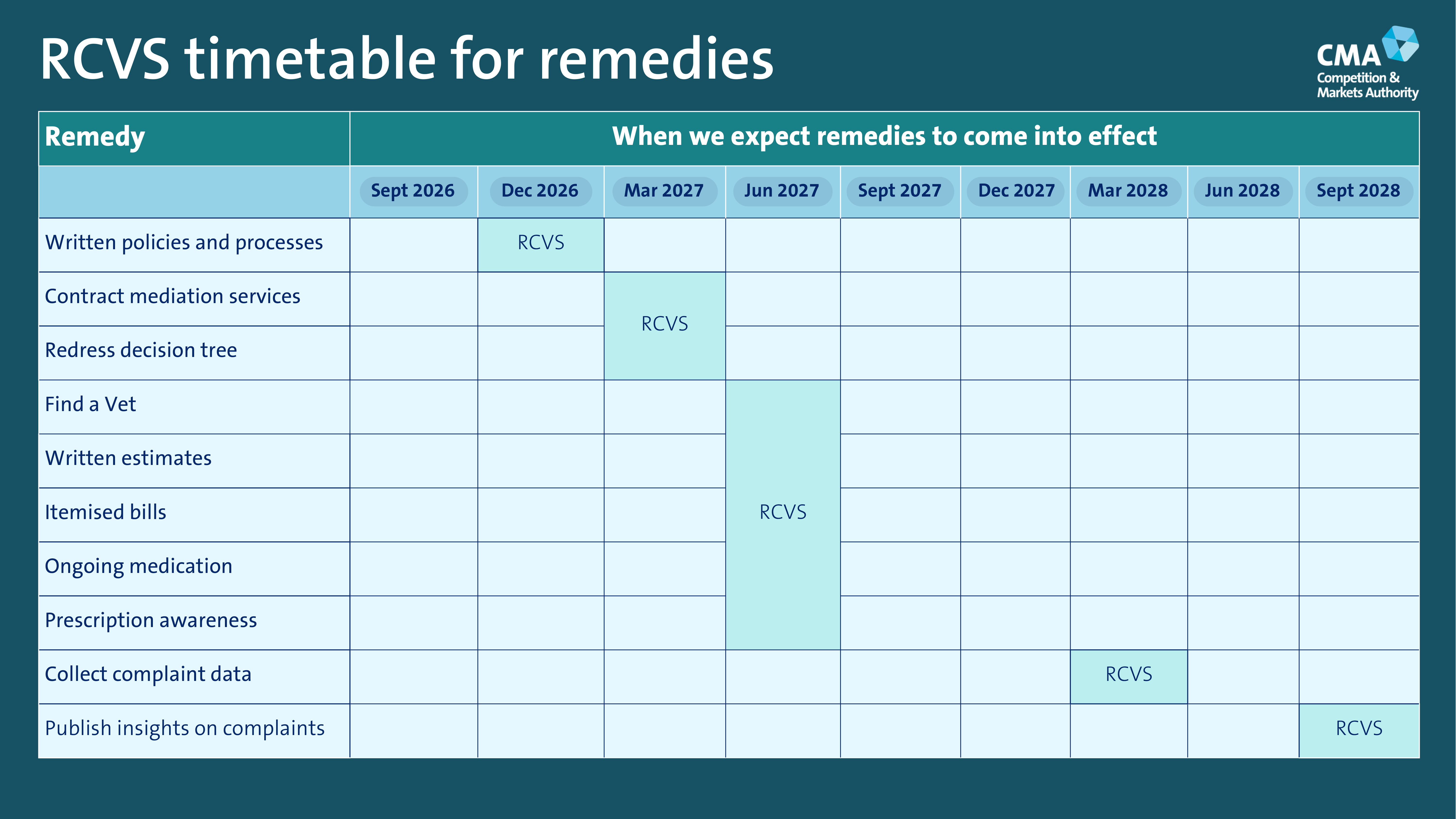
CMA veterinary remedies implementation timetable showing deadlines for larger and smaller businesses

Prescription fee caps

Prescription fees will be capped at £21 for the first medicine and £12.50 for each additional medicine on the same prescription – down from the £30+ many practices currently charge (GOV.UK guidance). Larger businesses have six months from the Order to comply. Smaller practices have 12 months.

Published price lists

Every practice must publish a standard price list covering consultations, common procedures, diagnostics, written prescriptions, and cremation options – broken down by pet weight category. That list must be accessible within one click of your website's homepage. Larger businesses have nine months; smaller practices have 12.

Written estimates for treatments over £500

If a treatment is expected to cost more than £500, you'll need to provide a written estimate in advance – including aftercare costs. Emergency care is the only exception.

Itemised bills

Every invoice must clearly itemise what was provided and what it cost. No more bundled totals.

Complaints management

Practices must implement a formal complaints process: written acknowledgement within five working days, a response within eight weeks, periodic log reviews, and the ability to share records with the RCVS on request. This is one of the most significant new obligations – and one most practices don't have a structured system for today.

Standardised prescription messaging

The RCVS's standardised text about the right to a written prescription must appear on appointment confirmations (emails and texts) and on invoices where medicine was dispensed.

Pet care plan transparency

If you offer pet care plans, you'll need to disclose savings calculations in detail – including the standalone price per item and whether services are once-in-a-lifetime or recurring.

Price comparison and branding

The large corporate groups will be required to clearly brand their practices so pet owners know who they're dealing with. A price comparison website is also part of the package.
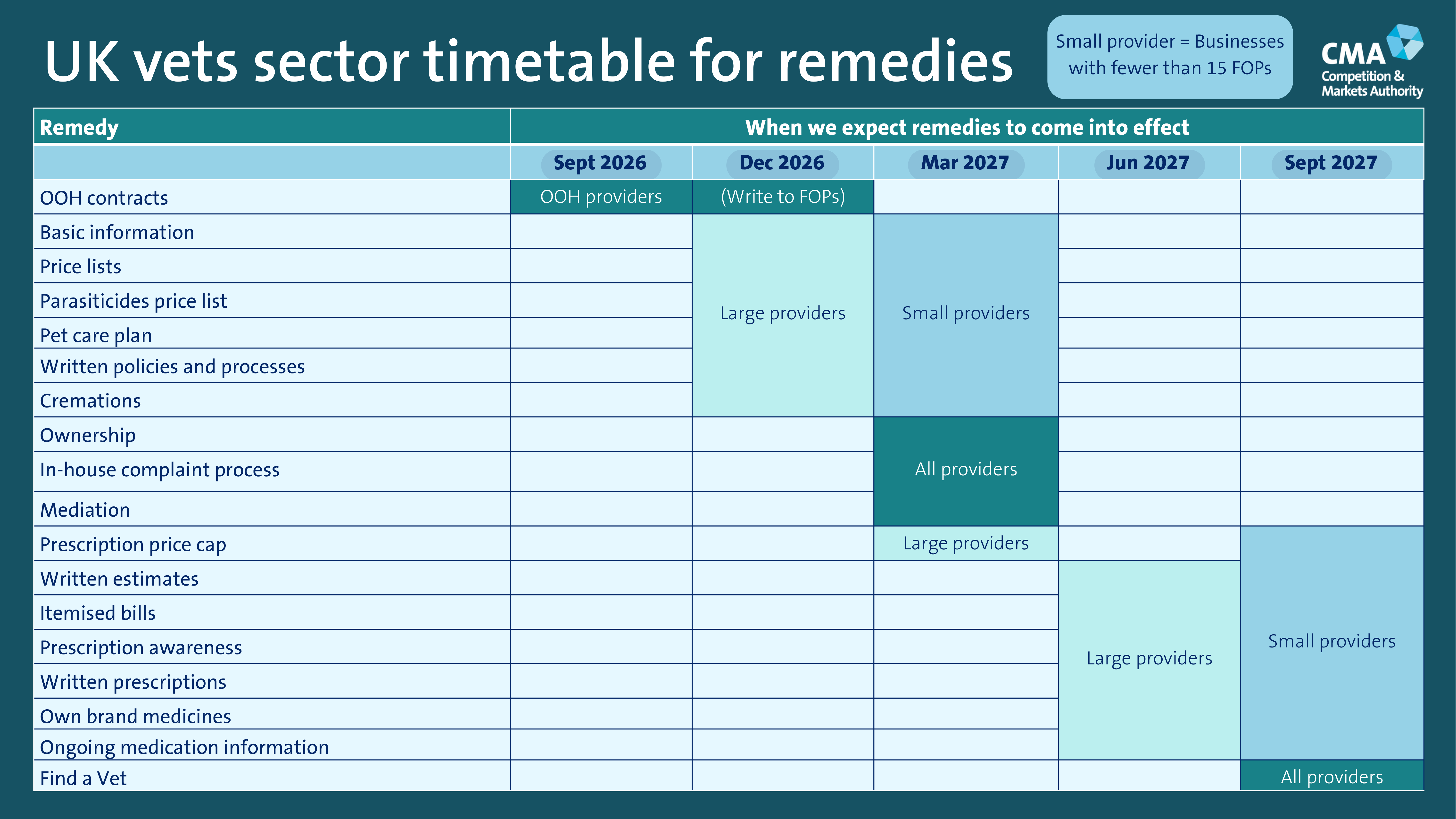
Detailed CMA timetable showing when each remedy takes effect for larger and smaller veterinary businesses

Where Provet already supports compliance

If you're a Provet practice, you're starting from a strong position. Several of these requirements map directly to features that are already part of your day-to-day workflows.

Itemised invoicing. Provet generates detailed, line-item invoices by default. For most practices, this requirement is already covered.

Consider taking a look at your invoice print settings in Provet. You may have fields hiding that you’ll need to display. 

Written estimates. Provet's estimate and quote functionality supports the £500 threshold requirement. You can create, review, reject and share written estimates directly within the workspace. For full transparency, Provet can show declined items & obtain eSignatures on estimates.

Prescription generation. Provet handles written prescriptions and supports the 48-hour digital delivery window the CMA requires. Your team can generate prescriptions, add your eSigntature and send them to your clients.

Repeat prescription tracking. Provet's prescription history lets you identify ongoing medications – which supports the new requirement to provide the RCVS flyer on the second dispensing of a medicine.

Online booking confirmations. In Provet, you can customize booking confirmations to contain price information for the consultation fee and any pre-booked standard treatments, plus a direct link to the price list on your website.

Standardised prescription text on communications. The CMA requires RCVS standardised text to appear on appointment confirmation emails/texts and on invoices/receipts where medicine was dispensed. This requires configurable communication templates. Provet can include this information in the relevant header and footers via print settings.

What we're working on

We're not pretending every requirement is covered today. Here's where we're actively investing.

Prescription fee automation. The CMA's fee cap means a written prescription should cost £21 for the first medicine and £12.50 for each additional item on the same prescription. Today, Provet handles written prescriptions and prescription fees separately – you generate the prescription, then manually add the fee as a separate charge. We're working on automating this so the £21 fee is applied the moment you generate a written prescription, with £12.50 added automatically for each additional item. No extra steps, no mental maths, and your invoices stay compliant from the start.

Prescription email delivery. Right now, sending a written prescription by email requires saving it as a PDF first, then sending it separately. We're working to bring email delivery directly into the prescription workflow – fewer clicks, faster compliance.

Complaints management. This is the area most likely to need a new process, regardless of what software you use. Start thinking about how your practice handles complaints today and what a structured workflow would look like. Provet's 2-Way Conversations will give clients a more accessible way to reach your team – and keep those exchanges in one place instead of scattered across email, phone, and text. You’ll also be able to set up communication templates and forms within Provet to standardise how your team acknowledges and responds to complaints, so nothing falls through the cracks.

Own-brand medication flagging. Invoices and medicine labels will need to state when a Reference Product alternative is available. This requires product-level flags in the formulary – something we're scoping now.

Price list data export. Your pricing data already lives in Provet. We're looking at how to make it easier to export and publish in the CMA's required format – by pet weight category, one click from your homepage.

What you should do now

1. Review the full CMA guidance. The official requirements page and implementation timetable (PDF) are the best starting points.

2. Audit your current workflows. Check whether your estimates, invoices, and prescription processes already meet the new standards – or where gaps exist.

3. Talk to your Provet account team. If you have questions about how specific requirements map to your Provet setup, reach out. We're here to help you work through it.

4. Plan for complaints management. This is the area most likely to need a new process, regardless of what software you use. Start thinking about how your practice handles complaints today and what a structured workflow would look like.

We're in this with you

Regulatory change is never simple, but it doesn't have to mean more admin on your plate. Our goal is the same as it's always been: helping your team spend less time on paperwork and more time on care.

We'll keep you updated as we roll out new features and configurations to support CMA compliance. If you're a Provet customer in the UK, expect to hear from us directly with specific guidance for your practice.

Questions about how the CMA ruling affects your practice? Talk to our team.

If you run a veterinary practice in the UK, you've probably been watching the Competition and Markets Authority (CMA) investigation for months. Today, the final report landed – and with it, a set of legally binding requirements that will change how every UK practice handles pricing, prescriptions, estimates, and complaints.

Here's what you need to know, what's changing, and how Provet is already helping practices stay ahead.

What the CMA found

The CMA's market investigation into veterinary services for household pets concluded that a lack of clear, accessible pricing information is producing weak competition and higher costs for pet owners across the UK. While the investigation focused heavily on the largest corporate groups, the new rules apply across the board – independent practices and multi-site operators alike.

The result: a set of legally binding remedies designed to give pet owners more transparency and more choice.

What's required – and by when

The CMA has six months (until 23 September 2026) to put its Orders in place. Once those Orders land, the clock starts for your practice. The full list of requirements is on GOV.UK. Here's a breakdown of the key ones.

CMA veterinary remedies implementation timetable showing deadlines for larger and smaller businesses

Prescription fee caps

Prescription fees will be capped at £21 for the first medicine and £12.50 for each additional medicine on the same prescription – down from the £30+ many practices currently charge (GOV.UK guidance). Larger businesses have six months from the Order to comply. Smaller practices have 12 months.

Published price lists

Every practice must publish a standard price list covering consultations, common procedures, diagnostics, written prescriptions, and cremation options – broken down by pet weight category. That list must be accessible within one click of your website's homepage. Larger businesses have nine months; smaller practices have 12.

Written estimates for treatments over £500

If a treatment is expected to cost more than £500, you'll need to provide a written estimate in advance – including aftercare costs. Emergency care is the only exception.

Itemised bills

Every invoice must clearly itemise what was provided and what it cost. No more bundled totals.

Complaints management

Practices must implement a formal complaints process: written acknowledgement within five working days, a response within eight weeks, periodic log reviews, and the ability to share records with the RCVS on request. This is one of the most significant new obligations – and one most practices don't have a structured system for today.

Standardised prescription messaging

The RCVS's standardised text about the right to a written prescription must appear on appointment confirmations (emails and texts) and on invoices where medicine was dispensed.

Pet care plan transparency

If you offer pet care plans, you'll need to disclose savings calculations in detail – including the standalone price per item and whether services are once-in-a-lifetime or recurring.

Price comparison and branding

The large corporate groups will be required to clearly brand their practices so pet owners know who they're dealing with. A price comparison website is also part of the package.

Detailed CMA timetable showing when each remedy takes effect for larger and smaller veterinary businesses

Where Provet already supports compliance

If you're a Provet practice, you're starting from a strong position. Several of these requirements map directly to features that are already part of your day-to-day workflows.

Itemised invoicing. Provet generates detailed, line-item invoices by default. For most practices, this requirement is already covered.

Consider taking a look at your invoice print settings in Provet. You may have fields hiding that you’ll need to display. 

Written estimates. Provet's estimate and quote functionality supports the £500 threshold requirement. You can create, review, reject and share written estimates directly within the workspace. For full transparency, Provet can show declined items & obtain eSignatures on estimates.

Prescription generation. Provet handles written prescriptions and supports the 48-hour digital delivery window the CMA requires. Your team can generate prescriptions, add your eSigntature and send them to your clients.

Repeat prescription tracking. Provet's prescription history lets you identify ongoing medications – which supports the new requirement to provide the RCVS flyer on the second dispensing of a medicine.

Online booking confirmations. In Provet, you can customize booking confirmations to contain price information for the consultation fee and any pre-booked standard treatments, plus a direct link to the price list on your website.

Standardised prescription text on communications. The CMA requires RCVS standardised text to appear on appointment confirmation emails/texts and on invoices/receipts where medicine was dispensed. This requires configurable communication templates. Provet can include this information in the relevant header and footers via print settings.

What we're working on

We're not pretending every requirement is covered today. Here's where we're actively investing.

Prescription fee automation. The CMA's fee cap means a written prescription should cost £21 for the first medicine and £12.50 for each additional item on the same prescription. Today, Provet handles written prescriptions and prescription fees separately – you generate the prescription, then manually add the fee as a separate charge. We're working on automating this so the £21 fee is applied the moment you generate a written prescription, with £12.50 added automatically for each additional item. No extra steps, no mental maths, and your invoices stay compliant from the start.

Prescription email delivery. Right now, sending a written prescription by email requires saving it as a PDF first, then sending it separately. We're working to bring email delivery directly into the prescription workflow – fewer clicks, faster compliance.

Complaints management. This is the area most likely to need a new process, regardless of what software you use. Start thinking about how your practice handles complaints today and what a structured workflow would look like. Provet's 2-Way Conversations will give clients a more accessible way to reach your team – and keep those exchanges in one place instead of scattered across email, phone, and text. You’ll also be able to set up communication templates and forms within Provet to standardise how your team acknowledges and responds to complaints, so nothing falls through the cracks.

Own-brand medication flagging. Invoices and medicine labels will need to state when a Reference Product alternative is available. This requires product-level flags in the formulary – something we're scoping now.

Price list data export. Your pricing data already lives in Provet. We're looking at how to make it easier to export and publish in the CMA's required format – by pet weight category, one click from your homepage.

What you should do now

1. Review the full CMA guidance. The official requirements page and implementation timetable (PDF) are the best starting points.

2. Audit your current workflows. Check whether your estimates, invoices, and prescription processes already meet the new standards – or where gaps exist.

3. Talk to your Provet account team. If you have questions about how specific requirements map to your Provet setup, reach out. We're here to help you work through it.

4. Plan for complaints management. This is the area most likely to need a new process, regardless of what software you use. Start thinking about how your practice handles complaints today and what a structured workflow would look like.

We're in this with you

Regulatory change is never simple, but it doesn't have to mean more admin on your plate. Our goal is the same as it's always been: helping your team spend less time on paperwork and more time on care.

We'll keep you updated as we roll out new features and configurations to support CMA compliance. If you're a Provet customer in the UK, expect to hear from us directly with specific guidance for your practice.

Questions about how the CMA ruling affects your practice? Talk to our team.

Key takeaways

Get fresh monthly veterinary insights

Get Provet news and product updates

Thanks for subscribing!
White dog balancing treat on nose with tongue out playfullyCute white dog balancing a treat on nose with tongue out

Related articles

Frequently Asked Questions About Open APIs: Freedom of Choice for Veterinary Teams
2026 Veterinary Pricing: How Recent Data Affects Price Increases
The Value of Client Service: Supporting Veterinary CSRs with Technology
Close Cookie Popup
Cookie Preferences
By clicking “Accept All”, you agree to the storing of cookies on your device to enhance site navigation, analyze site usage and assist in our marketing efforts as outlined in our cookie policy.
Strictly Necessary (Always Active)
Cookies required to enable basic website functionality.
Cookies helping us understand how this website performs, how visitors interact with the site, and whether there may be technical issues.
Cookies used to deliver advertising that is more relevant to you and your interests.
Cookies allowing the website to remember choices you make (such as your user name, language, or the region you are in).